What is the essence of Black struggle in as offered in “Tip of the Spear’s” 2nd chapter
For Black August, a small collective, via the Black Socialist Formation, is studying Orisanmi Burton’s Tip of the Spear: Black Radicalism, Prison Repression and the Long Attica Revolt. Earlier this week, we discussed the second chapter, “Black Solidarity Under Siege.” The chapter focuses on the third stage of that Revolt (the first two happening at The Tombs in Manhattan and Branch Queens, respectively) and stretches across the fall of 1970 into at least the late spring of 1971 at Auburn Prison in NY, although state records place it as November 2-4, 1970. One of his larger points on how we need to look at history, Burton challenges the ruling class story telling which limits a revolt simply to the time period where there is direct conflict with their state and points us to a more subtle and intricate examination that boots out linear timelines and challenges a study group to read closely to seek underlying dynamics.
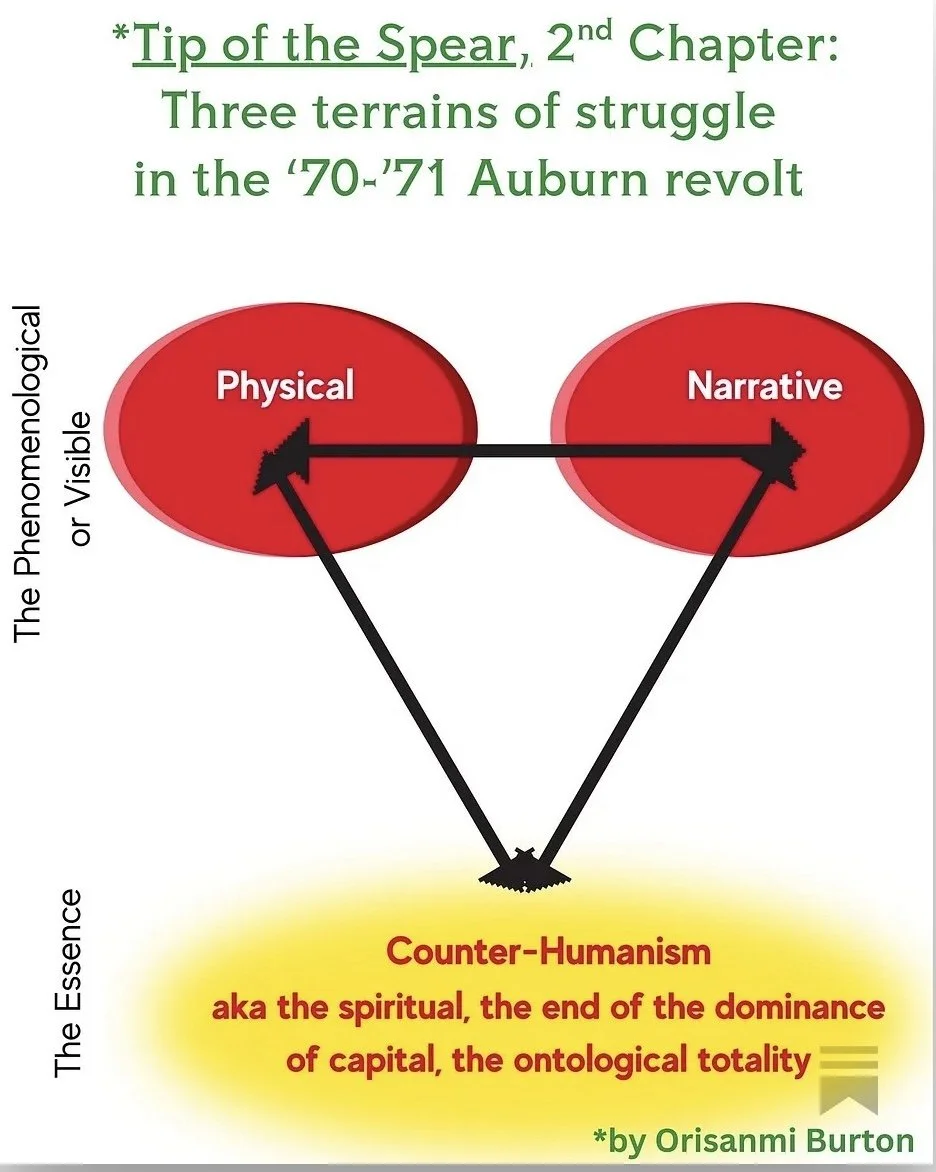
The chapter outlines three terrains of struggle: narrative, physical and counter-humanism, the latter including the spiritual, the ontological, the way of being in the world, a way that can’t be contained in the liberal humanist notion of pursuing “human rights.” The first two terrains are phenomena, what we can see, but they mask a deeper essence, the counter-humanism struggle, a struggle against a “humanism” which is hell-bent on excluding Black life, while needing it for its own sustenance. The counter-humanism struggle stretches beyond the easy legibility of reform, and is instead a struggle of self-actualization in the spirit of Cedric Robinson’s frame of “the Black Radical Tradition,” which I touched on in a recent article and note is named a couple of times in this chapter. Below is my effort to visually represent Burton’s argument. To be fair, Burton does not explain it in these terms, this is how I understand him.
One of many elements in this chapter is this beautiful, really important history of the narrative terrain of struggle. It tells of a shift in how people inside and outside the walls can communicate which has been made possible because of a lawsuit brought just prior to the Auburn revolt by the legendary Black anarchist, Martin Sostre, in his case Sostre v Rockefeller. Among other outcomes, the successful lawsuit allowed more expansive written communications to take place across the walls and Burton explains how this expanded communication facilitated critical advocacy provided by a predominantly White Marxist-Leninist formation of students, Youth Against War and Fascism (YAWF) when the participants in the revolt had released the hostages and the ruling class and their state went back on promises to not engage in retribution.
This history of the fight for expanded communication was really enlightening for me since I had not thought about how the across the walls letter-writing programs I have taken part in were made possible, (still restrained and censured though they are). To this notion of the narrative terrain of struggle, Burton points out that this allows a new archive to be created beyond what the (European capital class’s) state archive contains. We see the power of this archive at the end of the chapter when two of the children of leaders in the Auburn revolt share what their fathers wrote them over the years. It is heart wrenching to see these fathers diligently working to communicate grander lessons to their children about life and who they are and Burton argues this activity expresses a quality that stretches beyond the limits of the liberal human rights framework of parole reform, adequate living conditions and an end to the violence imposed via the state. This point is driven home when we think about how Sostre’s win in a liberal courtroom helps make the letters possible, but the communication is constrained by the impossibility of full free communication. A reality that has always marked the lives of Black people as an internal colony on this land and is clear today as well with the omni-surveilance.
For frames of prisoners of war, political, politicized, and prisoners of exile, that Black August challenges us to study, fast, train and fight alongside, as well as the broader group of “social prisoners,” Tip of the Spear demonstrates how quickly people can move across the those categories in responding to and being inspired by one another and the conditions on the ground. Tip of the Spear’s meticulous history really lends itself to studying as a group, and rereading at least once. Grateful for the the comrades who offered this as our study project and for those who created the structure of Black August that is pushing me to look even more closely. Looking forward to chapter three “Attica Is.” #BlackAugust